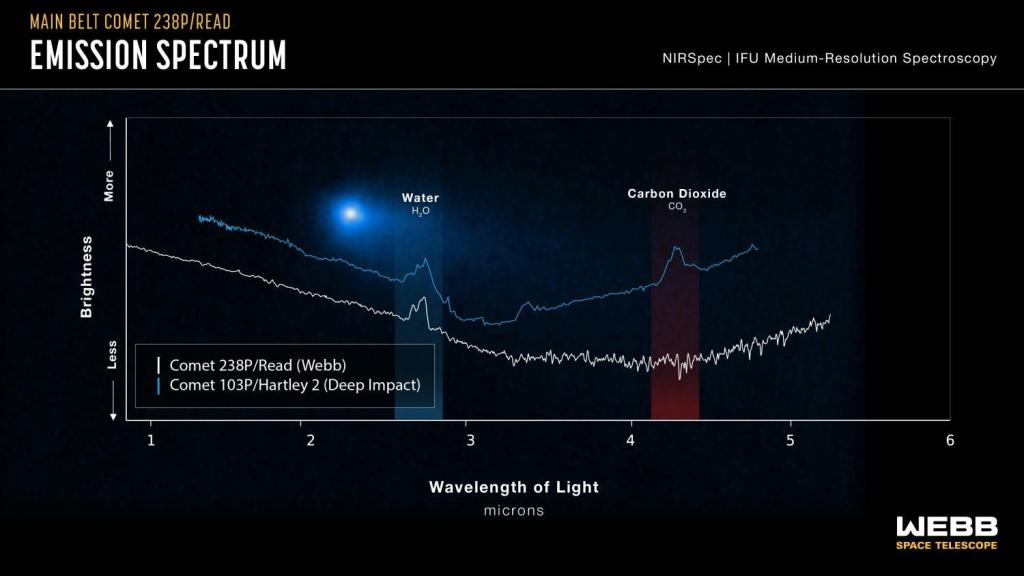
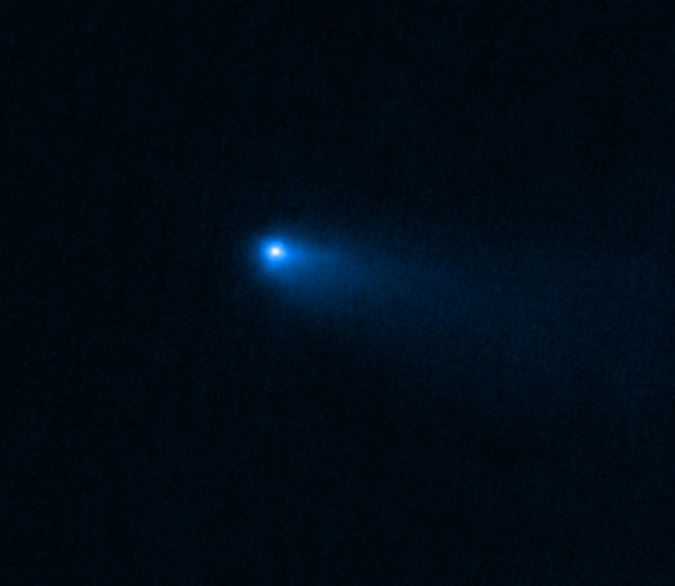
Researchers have confirmed the presence of water vapor around a rare comet in the asteroid belt between the planets Mars and Jupiter.

The discovery from the James Webb Space Telescope shows water ice from the early solar system can be preserved in the region.
Comet 238P/Read is unlike most other comets in that it doesn’t originate from beyond the orbit of the farthest planet in our solar system, Neptune.
While scientists were able to speculate that water ice could be preserved in the asteroid belt, these measurements are the first definitive proof.
No Carbon Dioxide was detected, which is unusual for comets. It could have been lost due to the relatively warmer temperatures in the asteroid belt as opposed to the Kuiper Belt.
Another explanation could be that Comet Read formed in a warmer part of the solar system where no CO2 was available.
The researchers say the discovery will help them understand how water is dispersed in solar system formation, and if other systems could host Earth-like planets.
The University of Arizona helped build The Near-Infrared Camera on James Webb Space Telescope, which detected the vapor. The study was published in the journal Nature.